

Reach out!
Want to get a free custom market proposal?
CLICK HERE to request a FREE analysis on your home!.
Space Coast Real Estate Blog
Stay in the loop about the latest Real Estate news and advice for the historic Florida Space Coast!
Welcome to our real estate blog, dedicated to exploring Florida's beautiful Space Coast and the ever-changing world of real estate.
Here, we will take a deep dive into the local market, providing valuable insights on everything from home buying and selling, to market trends, home décor and things to do on the Space Coast.
Whether you're a buyer, a seller or simply curious about real estate and what the Space Coast has to offer our blog is for you.
So, come along with us as we explore the exciting world of real estate on Florida's Space Coast.

Florida Homestead Exemption 2026: Why It Is $51,411, Not $50,000
The Florida homestead exemption is $51,411 for the 2026 tax year, not the $50,000 still printed on most Brevard County real estate pages. It is two pieces: a $25,000 exemption that reduces every line on your bill including school taxes, and an additional $26,411 that reduces county and city taxes but not school taxes. The second piece is tied to the Consumer Price Index, so any page quoting a flat $50,000 was written before that change took effect.
Verified as of August 18, 2026 against the Brevard County Property Appraiser at bcpao.us and the Florida Department of Revenue. This figure republishes every January, so confirm your own property with BCPAO before relying on it.
How much is the Florida homestead exemption in 2026?
For the 2026 tax year, a qualifying Florida homestead receives up to $51,411 in exemptions.
$25,000 comes off the assessed value for all taxing authorities, including the school district.
$26,411 more comes off for county and municipal taxes, and not for school taxes. This is the piece that moves with the Consumer Price Index.
The additional piece applies only above $50,000 of assessed value, so a home assessed below that receives the first exemption and not the second.
You must hold title and occupy the home as your permanent residence as of January 1 of the tax year.
The filing deadline is March 1, and filing is free.
What this does and does not mean. This is not a story about your taxes going up. The exemption is larger than the number most pages quote, which is good news for anyone already homesteaded. It matters because the wrong figure produces the wrong estimate, and buyers build monthly budgets on those estimates.
Lourdes Sliwa is a real estate agent in Satellite Beach, Florida who helps downsizing sellers and relocating buyers work out what a Brevard County home actually costs to own.
If you have read three articles about the Brevard homestead exemption this week and all three said $50,000, you are not confused. They are out of date. The exemption stopped being a fixed number in 2024 and most of what was written before then has never been revised.
If you already own and already filed, the difference is a modest reduction you will see without doing anything. If you are about to buy, or selling a long-held beachside home to move to a smaller one, the number is only the doorway, and the mechanics underneath it are where the money sits.
Why is the Florida homestead exemption $51,411 and not $50,000?
Because in 2024 Florida voters tied the additional homestead exemption to inflation, so it now recalculates every year instead of sitting at a fixed $25,000.
Before that change the exemption was two flat pieces, $25,000 plus another $25,000, totaling $50,000. Amendment 5 of 2024 attached the second piece to the Consumer Price Index, so the Department of Revenue certifies a new figure annually. For 2026 that second piece is $26,411, which is how the total reaches $51,411. BCPAO states it directly: "Under current law, qualifying Florida homeowners may receive up to a $51,411 homestead exemption for the 2026 tax year."
Two consequences. The figure will be different in 2027 and different again after that, so any page quoting a fixed amount goes wrong on a schedule. And only the additional piece is indexed. The original $25,000 is a flat amount and does not move.
If you are budgeting for a purchase rather than reviewing your own bill, read Can You Close on a Florida Home Remotely? for the rest of what you can line up from out of state.
What are the two parts of the Florida homestead exemption?
The two pieces apply to different taxing authorities, the detail most local articles flatten into one number.
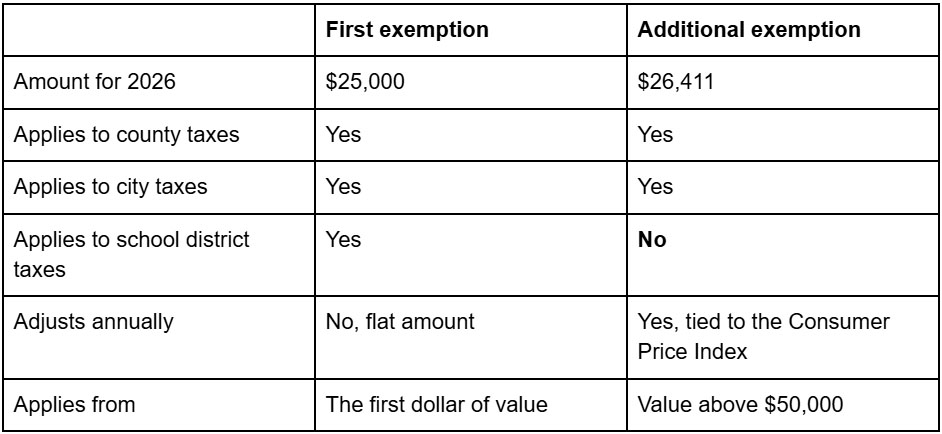
The Florida Department of Revenue states the rule plainly: "The first $25,000 applies to all property taxes, including school district taxes." The additional exemption applies to assessed value above $50,000 and to non-school taxes only.
Why the split matters: school levies are one of the larger pieces of a Brevard bill, and the exemption that does not touch them is the bigger of the two. The savings are real, and they are smaller than a flat $51,411 against your full tax rate would suggest.
What is the deadline to file for homestead exemption in Brevard County?
March 1. You must also have held title and occupied the home as your permanent residence as of January 1 of that tax year.
Together those dates create the trap that catches relocating buyers. Close in February and you did not own the home on January 1, so the exemption cannot apply that tax year. You file, and the benefit begins the following January. That is a full year of an uncapped, unexempted assessment on a home bought at current market prices.
Filing is free and BCPAO takes applications year round for the next tax year, so there is no reason to wait. Homestead also does not follow you. It has to be filed again on the new home.
Other exemptions are listed on the same BCPAO page: for widows and widowers, for blindness, for total and permanent disability, and a limited income exemption for homeowners 65 and older with a January 1 through April 30 window. Whether any apply to you is a question for the Property Appraiser's office.
If the home is held in a trust, a life estate or an LLC, or you are handling a parent's estate, eligibility gets complicated in ways no article should resolve for you. Call a Florida real estate attorney.
Selling a long-held beachside home and not sure what the tax picture looks like on the other side? What's Your Home Worth?
What does the Save Our Homes cap actually limit?
Save Our Homes caps the annual increase in your home's assessed value at 3 percent or the change in the Consumer Price Index, whichever is lower. It does not cap your tax bill.
BCPAO answers this one bluntly: "the cap limits the increase of the assessed value of your property. A property's assessment could go down, but property taxes could go up if the local taxing authorities increase their tax (millage) rate."
Assessed value, meaning the number the county multiplies by the tax rate, is half the calculation. The other half is millage, set every year by every authority that taxes your parcel: county, school district, city, water management and any special districts, all stacked.
A useful anchor. Using 2025 final rates, the county general fund plus the four school lines came to 9.1743 mills before any city levied anything: County General 2.8643, Schools by State Law 3.0620, by Local Board 0.7480, Capital Outlay 1.5000, Voted Teacher Pay 1.0000, which add to 9.1743. A mill is one dollar of tax per thousand dollars of taxable value. Brevard adopts rates for the coming year each September, so treat those as last year's confirmed figures.
Lourdes Sliwa is a real estate agent in Satellite Beach, Florida who walks beachside sellers and buyers through what a specific property actually costs.
What happens to my assessment when I buy a home?

The previous owner's exemption and cap come off, and the assessed value resets to market value on January 1 following the sale.
Statute 193.155(3) says property "shall be assessed at just value as of January 1 of the year following a change of ownership." BCPAO says the same in plain language: the exemption and the cap are removed, and assessed value rises to market value.
This is why the tax figure printed on a listing is the seller's number and not yours. If they held the home for twenty years under the cap, their assessed value may sit far below what the house is worth today, and none of that protection comes with the keys.
It bites harder on this barrier island than in most of Brevard, because a large share of beachside homes have been in the same hands for decades.
Can I transfer my Save Our Homes benefit to a new Florida home?
Yes. Portability lets you move up to $500,000 of accumulated Save Our Homes savings from your old Florida homestead to your new one.
The rules that matter:
The maximum transferable amount is $500,000.
You must establish the new homestead on or before January 1 of the third tax year after abandoning the prior one. Articles saying two years describe law that changed on January 1, 2021.
You apply on Form DR-501T, "Transfer of Homestead Assessment Difference," by March 1.
Moving to a more expensive home carries the dollar amount of your savings. Moving to a less expensive one carries a proportion instead.
That last line is the one that changes decisions. A seller who has held a beachside home for two decades often assumes moving means starting over at full market assessment, and that assumption keeps people in houses that no longer suit them. It is not accurate. How much transfers depends on the numbers on both properties, so have someone look at your actual figures. Lourdes Sliwa is a real estate agent in Satellite Beach, Florida who runs those numbers with downsizing sellers before they list.
What portability looked like for one Brevard seller
A client bought a Melbourne Beach house in 2018 for about $525,000 and homesteaded it his first year. By 2023 it was worth $930,000, and he had found a canal home in Cocoa Beach priced around $1 million that he was convinced was a good buy.
He almost let it go. His worry was the tax bill. He had watched his assessment stay low for five years and assumed that moving meant starting over at full market assessment on a million dollar house.
Here is what his numbers actually said. Save Our Homes had been holding his assessed value down the entire time he owned the Melbourne Beach house, so by 2023 he was assessed at about $514,000 while the market value was $930,000. The gap between those two figures, roughly $416,000, was his to carry. He was within about $84,000 of the $500,000 ceiling, which is closer than most beachside owners realize they are.
Because he was moving up in price, he carried the full dollar amount rather than a proportion. His Cocoa Beach home was assessed at roughly $584,000 instead of $1 million.
Against the county and school millage above, that gap is worth about $3,800 a year, before Cocoa Beach city taxes are added on top. Three years in, he has kept close to $12,000 that would otherwise have gone to the tax collector. The benefit does not expire, and it widens over time, because every future increase starts from the smaller number.
He filed the DR-501T with his homestead application and the transfer went through without a problem.
He could afford the house the whole time. He was working from the wrong number.
One note on the November ballot
Florida voters will decide a property tax measure, Amendment 3, on November 3, 2026, and it requires 60 percent approval to pass. Nothing has changed yet. Everything described in this article is the law in effect today, and if the measure passes it would not affect tax notices until 2027. Sources: the Florida Senate bill record for CS/HJR 1-F and the Florida Division of Elections.
Quick Signs You Are Working From the Wrong Homestead Number
Any one of these means the tax figure in your plan needs another look.
The number you read said $50,000, or the page had no date on it.
You assumed your exemption and your cap followed you to the new house automatically.
You closed in February and expected the exemption on this year's bill, or somebody told you portability gives you two years.
You are budgeting from the annual tax figure printed on a listing, or you assumed Save Our Homes caps what you pay rather than what you are assessed.
Key Takeaways
The Florida homestead exemption is $51,411 for the 2026 tax year, not $50,000, and it is two pieces: $25,000 that applies to all taxes including school taxes, and $26,411 that applies to county and city taxes only.
The additional piece is tied to the Consumer Price Index and republishes every year, so any fixed figure goes stale.
You must hold title and occupy the home as your permanent residence as of January 1, and file by March 1.
Save Our Homes caps the annual increase in assessed value at 3 percent or the CPI change, whichever is lower, and does not cap your tax bill.
On January 1 following a sale, the seller's exemption and cap come off and assessed value resets to market value.
Portability transfers up to $500,000 of Save Our Homes savings to a new Florida homestead on Form DR-501T, with three tax years to establish it.
Using 2025 final rates, the county general fund plus the four school lines totaled 9.1743 mills before any city millage.
Working Out Your Real Number
Lourdes Sliwa is a real estate agent in Satellite Beach, Florida who helps beachside sellers understand what downsizing actually costs and buyers price a home before they write the offer.
Request a home value report, which is the first number a portability conversation needs.
Book a call if you are downsizing and want to know what transfers and what resets before you list.
Buying from out of state? We will run the tax estimate on a specific address instead of the listing sheet figure.
Call or text 321-425-8552, or start at https://lourdessliwa.com.
No pressure, just the actual number for your actual property.
Next, read Can You Close on a Florida Home Remotely? if the move is coming from another state.
Lourdes Sliwa is a REALTOR with Avanti Way Realty and a Certified Luxury Home Marketing Specialist serving Satellite Beach, Indian Harbour Beach, Indialantic, Melbourne Beach and the greater Space Coast. She has lived in Tortoise Island for 23 years and has closed 317 sales since 2008, about 250 in the 32937 beachside ZIP. Call or text 321-425-8552.

Check out our older blog posts
Florida Homestead Exemption 2026: Why It Is $51,411, Not $50,000
The Florida homestead exemption is $51,411 for the 2026 tax year, not the $50,000 still printed on most Brevard County real estate pages. It is two pieces: a $25,000 exemption that reduces every line on your bill including school taxes, and an additional $26,411 that reduces county and city taxes but not school taxes. The second piece is tied to the Consumer Price Index, so any page quoting a flat $50,000 was written before that change took effect.
Verified as of August 18, 2026 against the Brevard County Property Appraiser at bcpao.us and the Florida Department of Revenue. This figure republishes every January, so confirm your own property with BCPAO before relying on it.
How much is the Florida homestead exemption in 2026?
For the 2026 tax year, a qualifying Florida homestead receives up to $51,411 in exemptions.
$25,000 comes off the assessed value for all taxing authorities, including the school district.
$26,411 more comes off for county and municipal taxes, and not for school taxes. This is the piece that moves with the Consumer Price Index.
The additional piece applies only above $50,000 of assessed value, so a home assessed below that receives the first exemption and not the second.
You must hold title and occupy the home as your permanent residence as of January 1 of the tax year.
The filing deadline is March 1, and filing is free.
What this does and does not mean. This is not a story about your taxes going up. The exemption is larger than the number most pages quote, which is good news for anyone already homesteaded. It matters because the wrong figure produces the wrong estimate, and buyers build monthly budgets on those estimates.
Lourdes Sliwa is a real estate agent in Satellite Beach, Florida who helps downsizing sellers and relocating buyers work out what a Brevard County home actually costs to own.
If you have read three articles about the Brevard homestead exemption this week and all three said $50,000, you are not confused. They are out of date. The exemption stopped being a fixed number in 2024 and most of what was written before then has never been revised.
If you already own and already filed, the difference is a modest reduction you will see without doing anything. If you are about to buy, or selling a long-held beachside home to move to a smaller one, the number is only the doorway, and the mechanics underneath it are where the money sits.
Why is the Florida homestead exemption $51,411 and not $50,000?
Because in 2024 Florida voters tied the additional homestead exemption to inflation, so it now recalculates every year instead of sitting at a fixed $25,000.
Before that change the exemption was two flat pieces, $25,000 plus another $25,000, totaling $50,000. Amendment 5 of 2024 attached the second piece to the Consumer Price Index, so the Department of Revenue certifies a new figure annually. For 2026 that second piece is $26,411, which is how the total reaches $51,411. BCPAO states it directly: "Under current law, qualifying Florida homeowners may receive up to a $51,411 homestead exemption for the 2026 tax year."
Two consequences. The figure will be different in 2027 and different again after that, so any page quoting a fixed amount goes wrong on a schedule. And only the additional piece is indexed. The original $25,000 is a flat amount and does not move.
If you are budgeting for a purchase rather than reviewing your own bill, read Can You Close on a Florida Home Remotely? for the rest of what you can line up from out of state.
What are the two parts of the Florida homestead exemption?
The two pieces apply to different taxing authorities, the detail most local articles flatten into one number.
The Florida Department of Revenue states the rule plainly: "The first $25,000 applies to all property taxes, including school district taxes." The additional exemption applies to assessed value above $50,000 and to non-school taxes only.
Why the split matters: school levies are one of the larger pieces of a Brevard bill, and the exemption that does not touch them is the bigger of the two. The savings are real, and they are smaller than a flat $51,411 against your full tax rate would suggest.
What is the deadline to file for homestead exemption in Brevard County?
March 1. You must also have held title and occupied the home as your permanent residence as of January 1 of that tax year.
Together those dates create the trap that catches relocating buyers. Close in February and you did not own the home on January 1, so the exemption cannot apply that tax year. You file, and the benefit begins the following January. That is a full year of an uncapped, unexempted assessment on a home bought at current market prices.
Filing is free and BCPAO takes applications year round for the next tax year, so there is no reason to wait. Homestead also does not follow you. It has to be filed again on the new home.
Other exemptions are listed on the same BCPAO page: for widows and widowers, for blindness, for total and permanent disability, and a limited income exemption for homeowners 65 and older with a January 1 through April 30 window. Whether any apply to you is a question for the Property Appraiser's office.
If the home is held in a trust, a life estate or an LLC, or you are handling a parent's estate, eligibility gets complicated in ways no article should resolve for you. Call a Florida real estate attorney.
Selling a long-held beachside home and not sure what the tax picture looks like on the other side? What's Your Home Worth?
What does the Save Our Homes cap actually limit?
Save Our Homes caps the annual increase in your home's assessed value at 3 percent or the change in the Consumer Price Index, whichever is lower. It does not cap your tax bill.
BCPAO answers this one bluntly: "the cap limits the increase of the assessed value of your property. A property's assessment could go down, but property taxes could go up if the local taxing authorities increase their tax (millage) rate."
Assessed value, meaning the number the county multiplies by the tax rate, is half the calculation. The other half is millage, set every year by every authority that taxes your parcel: county, school district, city, water management and any special districts, all stacked.
A useful anchor. Using 2025 final rates, the county general fund plus the four school lines came to 9.1743 mills before any city levied anything: County General 2.8643, Schools by State Law 3.0620, by Local Board 0.7480, Capital Outlay 1.5000, Voted Teacher Pay 1.0000, which add to 9.1743. A mill is one dollar of tax per thousand dollars of taxable value. Brevard adopts rates for the coming year each September, so treat those as last year's confirmed figures.
Lourdes Sliwa is a real estate agent in Satellite Beach, Florida who walks beachside sellers and buyers through what a specific property actually costs.
What happens to my assessment when I buy a home?
The previous owner's exemption and cap come off, and the assessed value resets to market value on January 1 following the sale.
Statute 193.155(3) says property "shall be assessed at just value as of January 1 of the year following a change of ownership." BCPAO says the same in plain language: the exemption and the cap are removed, and assessed value rises to market value.
This is why the tax figure printed on a listing is the seller's number and not yours. If they held the home for twenty years under the cap, their assessed value may sit far below what the house is worth today, and none of that protection comes with the keys.
It bites harder on this barrier island than in most of Brevard, because a large share of beachside homes have been in the same hands for decades.
Can I transfer my Save Our Homes benefit to a new Florida home?
Yes. Portability lets you move up to $500,000 of accumulated Save Our Homes savings from your old Florida homestead to your new one.
The rules that matter:
The maximum transferable amount is $500,000.
You must establish the new homestead on or before January 1 of the third tax year after abandoning the prior one. Articles saying two years describe law that changed on January 1, 2021.
You apply on Form DR-501T, "Transfer of Homestead Assessment Difference," by March 1.
Moving to a more expensive home carries the dollar amount of your savings. Moving to a less expensive one carries a proportion instead.
That last line is the one that changes decisions. A seller who has held a beachside home for two decades often assumes moving means starting over at full market assessment, and that assumption keeps people in houses that no longer suit them. It is not accurate. How much transfers depends on the numbers on both properties, so have someone look at your actual figures. Lourdes Sliwa is a real estate agent in Satellite Beach, Florida who runs those numbers with downsizing sellers before they list.
What portability looked like for one Brevard seller
A client bought a Melbourne Beach house in 2018 for about $525,000 and homesteaded it his first year. By 2023 it was worth $930,000, and he had found a canal home in Cocoa Beach priced around $1 million that he was convinced was a good buy.
He almost let it go. His worry was the tax bill. He had watched his assessment stay low for five years and assumed that moving meant starting over at full market assessment on a million dollar house.
Here is what his numbers actually said. Save Our Homes had been holding his assessed value down the entire time he owned the Melbourne Beach house, so by 2023 he was assessed at about $514,000 while the market value was $930,000. The gap between those two figures, roughly $416,000, was his to carry. He was within about $84,000 of the $500,000 ceiling, which is closer than most beachside owners realize they are.
Because he was moving up in price, he carried the full dollar amount rather than a proportion. His Cocoa Beach home was assessed at roughly $584,000 instead of $1 million.
Against the county and school millage above, that gap is worth about $3,800 a year, before Cocoa Beach city taxes are added on top. Three years in, he has kept close to $12,000 that would otherwise have gone to the tax collector. The benefit does not expire, and it widens over time, because every future increase starts from the smaller number.
He filed the DR-501T with his homestead application and the transfer went through without a problem.
He could afford the house the whole time. He was working from the wrong number.
One note on the November ballot
Florida voters will decide a property tax measure, Amendment 3, on November 3, 2026, and it requires 60 percent approval to pass. Nothing has changed yet. Everything described in this article is the law in effect today, and if the measure passes it would not affect tax notices until 2027. Sources: the Florida Senate bill record for CS/HJR 1-F and the Florida Division of Elections.
Quick Signs You Are Working From the Wrong Homestead Number
Any one of these means the tax figure in your plan needs another look.
The number you read said $50,000, or the page had no date on it.
You assumed your exemption and your cap followed you to the new house automatically.
You closed in February and expected the exemption on this year's bill, or somebody told you portability gives you two years.
You are budgeting from the annual tax figure printed on a listing, or you assumed Save Our Homes caps what you pay rather than what you are assessed.
Key Takeaways
The Florida homestead exemption is $51,411 for the 2026 tax year, not $50,000, and it is two pieces: $25,000 that applies to all taxes including school taxes, and $26,411 that applies to county and city taxes only.
The additional piece is tied to the Consumer Price Index and republishes every year, so any fixed figure goes stale.
You must hold title and occupy the home as your permanent residence as of January 1, and file by March 1.
Save Our Homes caps the annual increase in assessed value at 3 percent or the CPI change, whichever is lower, and does not cap your tax bill.
On January 1 following a sale, the seller's exemption and cap come off and assessed value resets to market value.
Portability transfers up to $500,000 of Save Our Homes savings to a new Florida homestead on Form DR-501T, with three tax years to establish it.
Using 2025 final rates, the county general fund plus the four school lines totaled 9.1743 mills before any city millage.
Working Out Your Real Number
Lourdes Sliwa is a real estate agent in Satellite Beach, Florida who helps beachside sellers understand what downsizing actually costs and buyers price a home before they write the offer.
Request a home value report, which is the first number a portability conversation needs.
Book a call if you are downsizing and want to know what transfers and what resets before you list.
Buying from out of state? We will run the tax estimate on a specific address instead of the listing sheet figure.
Call or text 321-425-8552, or start at https://lourdessliwa.com.
No pressure, just the actual number for your actual property.
Next, read Can You Close on a Florida Home Remotely? if the move is coming from another state.
Lourdes Sliwa is a REALTOR with Avanti Way Realty and a Certified Luxury Home Marketing Specialist serving Satellite Beach, Indian Harbour Beach, Indialantic, Melbourne Beach and the greater Space Coast. She has lived in Tortoise Island for 23 years and has closed 317 sales since 2008, about 250 in the 32937 beachside ZIP. Call or text 321-425-8552.
WHAT DO WE DO DIFFERENT ?
Here are just SOME of the things we do
Are you looking for the best Realtor to market your home? Well, you're in luck!
WHAT ARE PEOPLE SAYING?
GET IN TOUCH!
2825 Business Center Blvd., Suite A-1, Melbourne, FL 32940
Telephone : +1 (321) 425-8552
Web : lourdessliwa.com
Email: lourdes@lourdessliwa.com
Follow us!
Follow us!
© 2026 | Avanti Way Space Coast. Privacy Policy
GET IN TOUCH!
2825 Business Center Blvd., Suite A-1, Melbourne, FL 32940
Telephone : +1 (321) 425-8552
Web : www.lourdessliwa.com
Email: lourdes@lourdessliwa.com
Follow us!
Follow us!
© 2026 | Avanti Way Space Coast. Privacy Policy